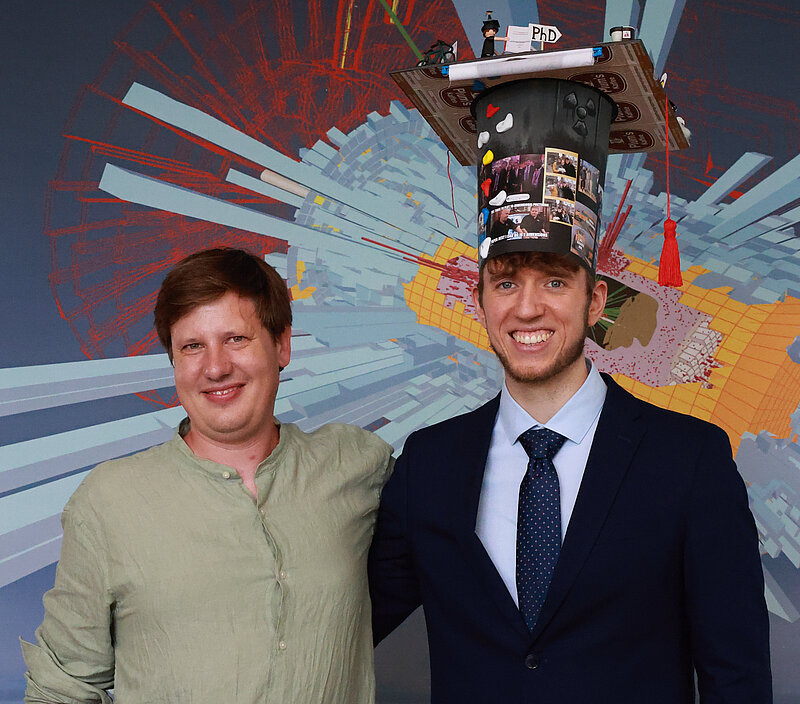
Benjamin Jung completed his dissertation titled “On Isotopic Ratio Signatures for Nuclear Archaeology: A Bayesian Approach for Verifying Fissile Material Declarations” at RWTH Aachen University. The thesis was supervised by Malte Göttsche (CNTR/PRIF) and Achim Stahl (RWTH Aachen).
Peaceful, cooperative, and sustainable nuclear disarmament requires means for technical verification, such as those comprising “nuclear archaeology”. Benjamin Jung’s work continues development of a novel nuclear archaeology technique called Bayesian Reprocessing Waste Analysis Method (BRAM), which proposes the use of isotopic signatures in samples of reprocessing waste to reconstruct reactor operating histories for the purpose of verifying fissile material baseline declarations.
First, a new, genetic algorithm was developed to optimize the choice of isotopic ratios that are used to inform the reconstruction process. This proposed set of isotopic ratios is chosen to be able to discriminate between three different reactor types, namely PHWR, PWR, and Magnox; and reconstruct previously neglected inference parameters, that is, initial enrichment and average power density.
With two systematic, simulation-based test series this ratio set was shown to successfully reconstruct four reactor operating parameters covering a large variety of possible true parameter combinations while focusing on the low burnup regime (0.1MWd kg−1 to 9MWd kg−1), which is more relevant for military plutonium production. The first test series showed the potential to reconstruct parameters when waste from two reactor cycles from different reactors has been mixed in a sample. The second test series showed the possibility to discriminate between three reactor types, if the origin of the sample is unknown, while simultaneously inferring the operating history parameters.
Building on these simulation-based results, steps towards validating this Bayesian framework are taken with experimental data from the SFCOMPO database. Here, parameters such as average burnup, power density, initial enrichment are reconstructed successfully for a PWR reactor and burnup, cooling time, and power density for a Magnox reactor type, demonstrating the working principle of the method; while highlighting the need for accurate uncertainty assessments.
Finally, a simulation-based case study of reconstructing the operating history of the Democratic People’s Republic of Korea’s 5Mwe reactor demonstrates the potential utility of the Bayesian framework, showing that existing assumptions about the reactor’s history could be corroborated or disproven and that there is potential to ascertain more information about the early reactor operations. All in all, this work shows promising steps forward in the development of the BRAM as a tool for reconstructing reactor operating histories and verifying nuclear disarmament.