
CNTR Monitor
Coming soon: CNTR Monitor 2026
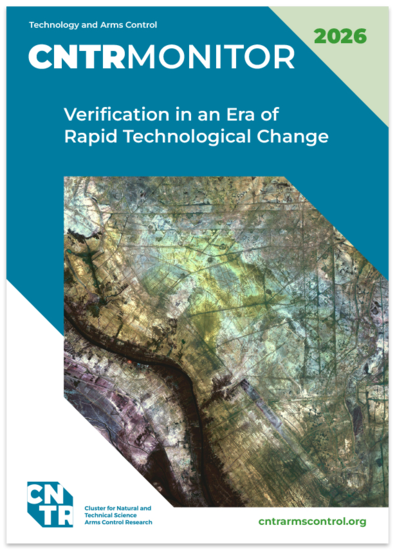
Verification in an Era of Rapid Technological Change
Rapid scientific and technological advancements may change the verification landscape of the future. Only few arms control treaties with formal verification regimes remain in place. Still, producing collective knowledge on activities that could destabilize peace and security remains crucial. The CNTR Monitor 2026 examines new opportunities for verification—with and without treaties.
Verification knowledge needs to be reliable and internationally accessible. New technologies can help improve existing verification regimes but also present novel challenges. By analyzing selected technologies and political shifts, the CNTR Monitor 2026 sheds light on the dynamics that shape verification in the new security environment.
The CNTR Monitor 2026 – Verification in an Era of Rapid Technological Change will be published on November 3, 2026.
Register for the online book launch on November 5, 2026, 14:00 – 15:30 CET (Germany) | 08:00 AM – 09:30 AM EST (US East Coast)
CNTR Monitor 2025
New Realities of AI in Global Security
The current boom in artificial intelligence may have significant impacts on global security. Emerging dual-use and military applications create new realities on battlefields and beyond. The CNTR Monitor 2025 examines current challenges and opportunities posed by AI. Instead of long-term doomsday scenarios, it looks at how AI has materialized in existing systems and why we need new approaches to regulation.
Three major implications are considered. First, the growing use of AI in military planning and strategic state behavior. Second, dual-use risks emerging in domains such as biotechnology and chemical synthesis. Third, opportunities and challenges of using AI for verification and monitoring in arms control. In addition, the CNTR Monitor sheds light on selected recent technology trends and analyzes their implications for global security.
Open Access Publication
Authors:
Prof. Dr. Christopher Daase, Carlo Diehl, Dr. Carmen García López, Prof. Dr. Malte Göttsche, Dr. Una Jakob, Abdullah Kasim Korkusuz, Dr. Sarah McKee, Lukas Rademacher, Dr. Thomas Reinhold, Dr. Kadri Reis, Prof. Dr. Dr. Christian Reuter, Dr. Stefka Schmid, Dr. Yan-Jie Schnellbach, Dr. Niklas Schörnig, Liska Suckau, Fabian Unruh

Research and development initially conducted in the civilian sector can in many cases be used for military purposes or misused for malicious purposes by non-state actors. Scientific and technological progress makes the regulation of dual-use items increasingly complex and poses a growing challenge to peace and security.
The CNTR Monitor 2024 takes an interdisciplinary look at the many perspectives associated with the topic of dual use. From artificial intelligence and semiconductors, drones and additive manufacturing to the unintended consequences of biological and medical research, but also new opportunities for arms control – the relevant actors and the political and legal frameworks are as diverse as the objects and technologies. The CNTR Monitor 2024 sheds light on various dual-use issues, highlights possibilities for political control and assesses the opportunities and risks of selected new technologies.
Open Access Publication
Authors:
Prof. Dr. Christopher Daase, Prof. Dr. Malte Göttsche, Abdullah Kasim Korkusuz, Dr. Una Jakob, Prof. Dr. Thilo Marauhn, Dr. Thomas Reinhold, Dr. Kadri Reis, Dr. Niklas Schörnig, Liska Suckau

About CNTR Monitor – Technology and Arms Control
The CNTR Monitor is an annual open-access publication and the core product of CNTR's research. It highlights technological innovations and developments in the natural sciences that are relevant to peace and security. In addition to analyses of individual technologies and reports on research and development (R&D) activities, the Monitor also explores opportunities for arms control and outlines options for political regulation.
The CNTR Monitor, first published in the fall of 2024, primarily addressing policymakers, practitioners, scientists, and the interested public. It is available in both German and English.
Back to Publications


